The armrest is settled. Say it out loud.
There is one rule in our Guide that leads public opinion rather than follows it, and it is the one people ask about most. The middle seat gets both armrests. The aisle
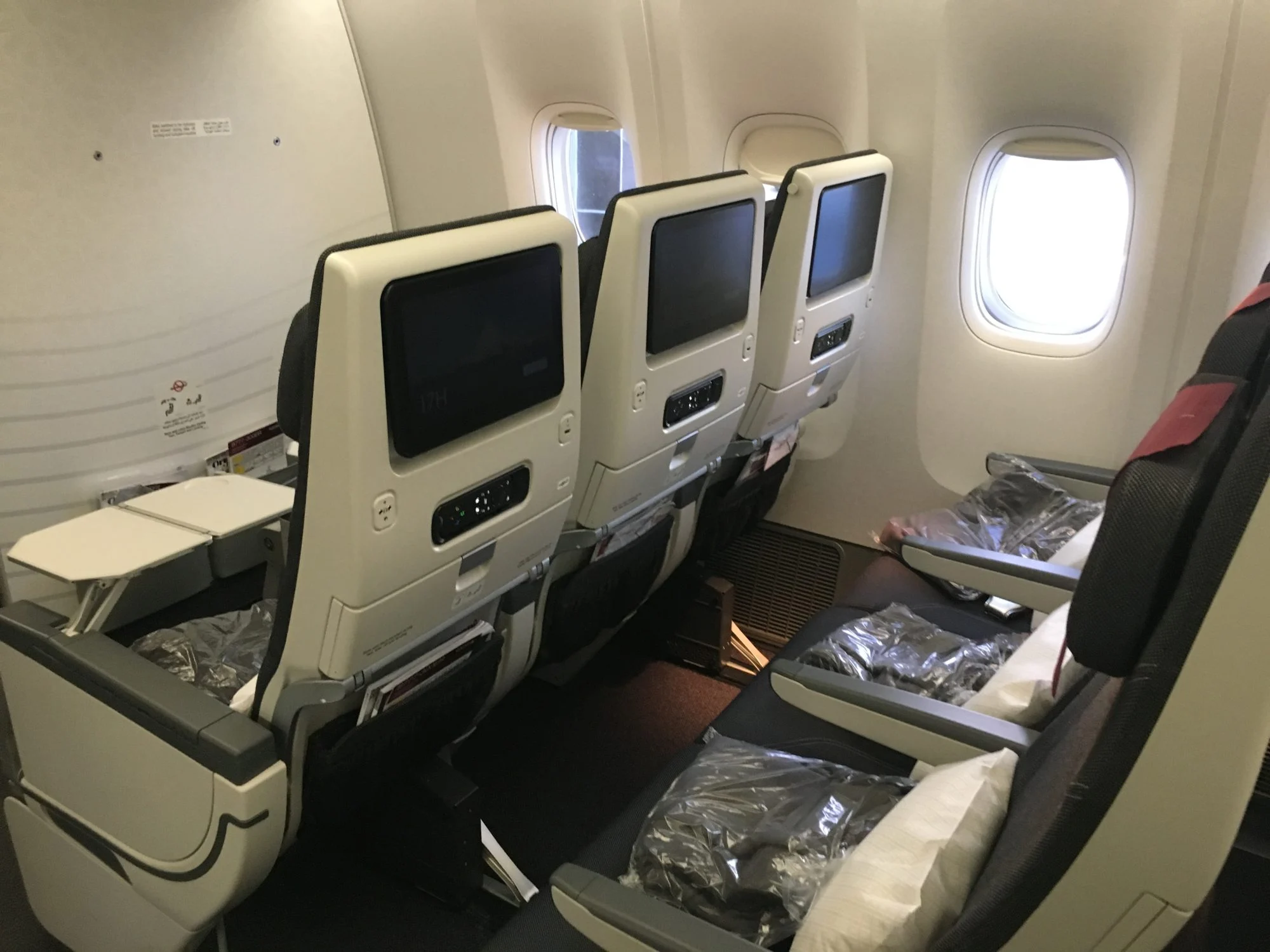

The middle seat gets both armrests. The aisle passenger can lean into the aisle, the window passenger can lean into the wall, and the middle passenger has nowhere to go, which is why the two armrests are theirs.
The public has not arrived at the same place. In a survey of more than 2,500 U.S. adults conducted by YouGov for The Points Guy in July 2026 and published August 28, 2026, 11 percent said the middle seat gets both armrests, 20 percent said the middle seat gets priority, 31 percent said they share equally, and 26 percent said they were not sure.
A quarter of the traveling public has no view at all on the most common physical negotiation in commercial aviation. Not a different view. No view. They board an aircraft, sit down beside two strangers, and improvise.
That is the actual problem, and it is separate from the question of who is right. A rule that half the cabin has never heard of cannot function, however sound it is. What fills the vacuum is whoever is more assertive, or arrived first, or is simply larger, and outcomes that track confidence are a poor way to allocate anything.
The public is not uncertain about the boundary itself. In the May 2024 survey published by YouGov on June 10, 2024, 74 percent of Americans said taking a neighbor’s armrest is unacceptable. Three-quarters of the country agree that the armrest marks the edge of somebody’s space and that crossing it is a violation. The confusion is only about where the line sits when three people share two armrests, and the arithmetic does not work.
Which is why a stated default helps. Where a situation has no natural answer, and where the parties will not be seeing each other again, a rule everyone knows is worth more than a rule that is theoretically fairer and unheard of. Traffic works this way. There is nothing morally superior about driving on one side of the road. What matters is that everyone knows which side.
The case for the middle seat is short. The aisle seat has room to lean, room to stretch a leg, and the ability to stand without asking. The window seat has a wall and a view. The middle seat is the only one of the three with no relief in either direction, and it is very often the seat nobody chose. Giving it the armrests is the smallest available correction to a real imbalance, and it costs the other two passengers something they can afford to lose.
The 31 percent who say they share equally are not being unreasonable. Sharing is the instinct of decent people, and plenty of rows manage it. But sharing requires negotiation between strangers in a confined space, which is the thing most people are trying to avoid. A rule removes the negotiation. That is its entire function.
The second half of this gets less attention, and it matters just as much. The armrest is a boundary, and nothing of yours crosses it. Not an elbow, not a knee. Sitting with your knees spread into the next seat is the same as an elbow on someone else’s armrest; it happens more often, and it is almost never named.
So, the practice. If you are in the middle, the armrests are yours, and you do not have to ask for them or apologize for using them. If you are in the aisle or the window and would like a turn, ask. In twenty-four years in the aisle, where the first duty is always safety and the service is what you do with the rest of the hours, I watched middle-seat passengers share almost every time they were asked, because being asked is the whole difference between a courtesy and a seizure. And if you are the one asked, you are allowed to say no. That is what makes it a request.
Airlines should say the sentence. One line in a boarding announcement or one card in the seat pocket: the middle seat gets the armrests, because the aisle can lean into the aisle and the window can lean into the wall. It needs no capital expenditure, no new seat, and no software, and it is the cheapest improvement to the passenger experience available to any carrier in the world. Until a carrier does it, tell the person you are traveling with, and tell the colleague who flies twice a month and has never thought about it. The 26 percent who are not sure are not resistant. They have never been given an answer, and an answer with a reason attached tends to stick on first hearing.
Attribute to Gailen David, founder of Jetiquette®. Press requests are answered within two hours.
Request a quote Read next
United now requires headphones. The rest should follow.
Read next
United now requires headphones. The rest should follow.